Identify the line and who is responsible for it
Water in a yard may involve a service line, irrigation branch, exterior fixture, drainage issue, or another source. The wettest surface location is a starting observation, not a confirmed excavation point. First establish which connected line is suspected and whether the investigation concerns metered water loss.
Contact the serving water utility if water appears near its equipment or the boundary of responsibility is unclear. Ownership and maintenance arrangements should be confirmed for the actual property. A meter location alone does not settle every responsibility question, especially where several buildings or shared systems are involved.
Exterior symptoms to record
Compare the area with its recent irrigation and rainfall history. Wet soil following scheduled watering can require a different investigation from persistent moisture while the system is inactive. Changes in ground or planting conditions provide clues but should be considered alongside consumption and accessible plumbing observations.
- A patch remains unusually wet after nearby surfaces have dried.
- Water collects beside a driveway, walkway, or known buried pipe route.
- Unexplained metered flow continues when known indoor and outdoor uses are inactive.
- An irrigation zone behaves differently or a valve area remains wet between cycles.
- A new exterior symptom appears after digging, landscaping, or other work near buried lines.
Possible causes and the importance of pipe records
Buried pipes can develop defects at their walls or connections. EPA identifies aging materials, corrosion, pressure irregularities, installation problems, and equipment faults among possible causes of leaks generally. For a particular line, the explanation should follow inspection findings rather than an assumption that every old or buried pipe has failed.
Previous additions, irrigation modifications, and abandoned branches can make records incomplete. Share whatever plans and repair history you have, but label uncertain routes as uncertain. Knowing the likely material and connections helps the provider select tests and interpret results; an old drawing should not be treated as a current excavation map.
A practical investigation before excavation
An independent provider may first compare meter behavior with known uses and accessible branch isolation. The purpose is to distinguish an indoor concern from an exterior service or irrigation concern where the layout permits. A valve that does not isolate the intended area can leave that conclusion uncertain.
Route investigation and leak localization answer different questions. Establishing a pipe path helps organize the search, while leak evidence supports a specific suspect area. Ask the provider to explain how each mark was established and whether it represents a pipe route, another utility, or a suspected defect.
Acoustic correlation can use matching leak noise measured at two suitable points and information about the intervening pipe. Sewerin's guidance requires consideration of material, diameter, length, and sound velocity. Unknown branches or mixed materials should be discussed as part of interpreting the location.
Before excavation, review the proposed access area and utility coordination. Ask what will happen if the first opening does not expose the expected defect and when additional authorization will be requested. Agree on responsibility for protecting paving, landscaping, and access routes.
Compare buried-line investigation methods
Compare the proposed methods against the line being investigated. Ask why the combination suits its material, accessible fittings, route uncertainty, and operating conditions. A useful explanation connects the chosen tests to a specific question and identifies what could remain unresolved before excavation is discussed.
| Method | Potential use | Important limit |
|---|---|---|
| Meter observation and branch isolation | Assess unexplained flow and narrow the connected area. | Does not identify the buried defect's location. |
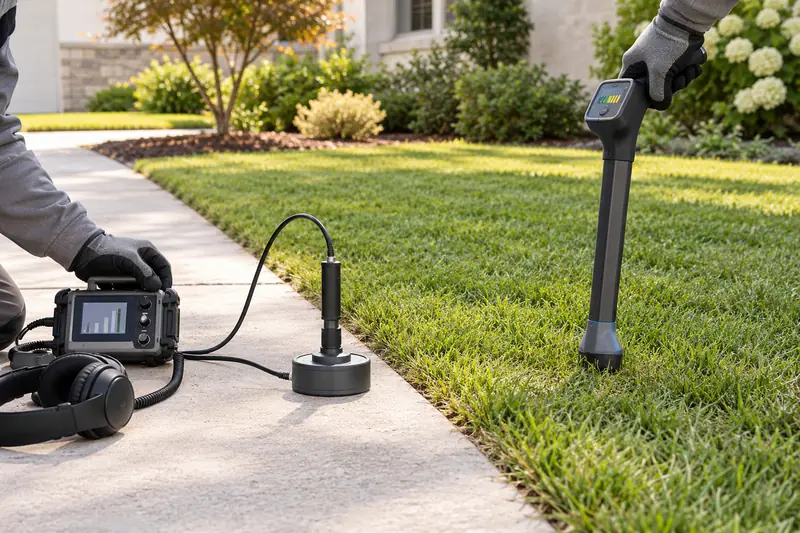
| Valve or ground listening | Compare sound evidence near accessible fittings or along a route. | Needs a usable leak signal; pipe and site conditions affect interpretation. |
| Acoustic correlation | Estimate a location between suitable measurement points. | Requires recognizable matching noise and suitable pipe information. |
| Pipe locating | Investigate a buried route using a method compatible with the line. | A marked route does not prove that the pipe leaks at a particular point. |
| Tracer gas investigation | Search for test gas escaping from a prepared isolated pipe section. | Requires specialist preparation; ask how gas observations will be linked to a repair location. |
| Drain camera and sonde | View an accessible drain and locate the camera position where compatible. | A sonde marks the camera location, not automatically a leak, and does not inspect supply piping. |
Preparation for yards and paved areas
Provide gate access, known meter and valve locations, controller information, and a sketch of affected areas. Identify parked vehicles, planters, stored materials, or locked spaces that may restrict the investigation. Tell the provider if the line serves more than one structure or if an interruption requires coordination with other occupants.
Record irrigation schedules and any recent changes rather than repeatedly running a suspect zone to demonstrate the problem. Do not dig exploratory holes or operate utility-owned valves as preparation. If a provider proposes tracer gas testing, ask about isolation, water interruption, and restoring service; Sewerin's referenced procedure requires water pipes to be emptied for that inspection.
- Photograph wet areas with fixed landmarks for location reference.
- Share previous trench routes and descriptions of repaired or abandoned lines.
- Identify privately installed lighting, outbuilding services, and irrigation branches.
- Confirm permission for marking surfaces and for any later access or excavation.
Utility marking and leak detection have different purposes
DigAlert serves Los Angeles County and coordinates notifications for underground utility marking. Its guidance explains that participating utilities mark facilities they own or maintain; private lines and certain nonpressurized drains may not be covered. Ask which additional private locating or facility checks are needed for the planned work.
A leak-location mark does not replace the excavation notification and clearance process. Likewise, utility markings do not diagnose a water leak or necessarily identify every private branch. Have the excavating party confirm the current requirements, responses, and precautions before work begins. Keep the detection findings available to everyone involved in planning access.
What affects cost and the final repair scope
Investigation costs depend on the suspected line length, route uncertainty, accessible fittings, connected branches, and surface conditions. Paving, restricted access, or missing records can require additional steps. Ask whether route investigation, leak localization, utility coordination, and written findings are included in the proposed assessment.
Excavation, repair, backfill, and surface restoration may be separate work. Request terms identifying who performs each part and how changes are approved. A supported local defect may lead to a targeted repair discussion; repeated failures or other findings may justify comparing a wider replacement. Detection alone does not establish the condition of the entire buried system.
After repair, agree on how the affected line will be checked and service restored. Existing wet soil may need further observation, so discuss what changes should prompt follow-up. Call Hydriva with the water-use history, outdoor symptoms, and available pipe records to discuss the buried-line investigation your property needs.
Keep route information and leak-localization findings labeled separately. An identified pipe route does not automatically identify the point of escape. Ask the provider to explain which marks describe known fittings, an inferred route, a search area, or a proposed access point. Photograph authorized markings before they disappear and retain the written explanation. If excavation is later proposed, make sure the excavation contractor receives the current findings and confirms the required utility coordination rather than relying on an unexplained mark on the ground.
Inspection notes
When comparing the findings with a repair proposal, use the guide to reading a leak detection report to separate tested boundaries, suspected locations, and confirmed defects.
Underground Leak Detection questions
What changes the cost of an underground-leak investigation?
Unknown routes, line length, connected branches, access points, and paved surfaces can change the work. Distinguish route tracing and leak localization from excavation, repair, backfill, and restoration. Call with the address, exterior symptoms, and any pipe records to discuss the appropriate diagnostic scope.
How do I discuss buried-line testing for my property location?
Provide the city, state, address, utility account, and the suspected private line. Explain shared access, irrigation branches, and whether the wet area is on private or public property. Call to confirm the address and scope; utility marking and a private leak investigation answer different questions.
Does the wettest spot in my yard show exactly where to dig?
No. Treat it as an observation to investigate alongside the connected systems, pipe route, and other findings. Rainfall, irrigation, and drainage conditions can also explain wet ground. Ask the independent provider what evidence supports the proposed excavation point and whether the mark represents a confirmed location or a suspect area. Digging at the most visible puddle without establishing the line involved can leave the original question unresolved.
Can an underground plastic water pipe be investigated acoustically?
Potentially. Sewerin's equipment guidance addresses the lower-frequency noises often associated with plastic pipes, so plastic does not automatically rule out acoustic investigation. The provider still needs suitable access, a usable signal, and an appropriate setup. Ask what alternative or additional method is proposed if the evidence is weak. Do not accept either a universal promise of success or a statement that every plastic line is impossible to investigate.
Will DigAlert mark the leaking water line on my property?
DigAlert coordinates utility notifications; participating owners or their locators mark the facilities they own or maintain. That may leave private property lines or other facilities outside the marking scope. Its guidance also identifies exceptions for certain nonpressurized drains. Ask the excavating party to confirm the markings and any additional private locating needed. The process helps plan excavation but does not determine which water line is leaking or establish the leak point.
How can the provider distinguish an irrigation leak from a service-line leak?
The provider may review the layout, controller history, meter observations, and suitable isolation checks to see which connected section remains suspect. This depends on the actual plumbing and functioning valves; turning a controller off does not necessarily isolate every water-fed component. Ask which branches were included and what uncertainty remains. If the system serves several buildings or irrigation areas, provide that information before agreeing to a narrowly defined investigation.
What should a report include before I approve excavation?
Request the suspected line, methods used, observed results, marked location or search area, and any limitations. Clarify how pipe-route marks differ from the suspected defect and from other utility markings. Ask who coordinates excavation clearance and private line locating, who restores the surface, and how an unsuccessful first opening would be handled. A useful report supports an access decision while stating uncertainty; it should not imply that detection has inspected every buried connection.
Related inspection guides
Compare other leak detection services from Hydriva, or find your city and state in the location directory.
Sources and further reading
- EPA WaterSense: Household leak causes
- Sewerin: SeCorr C 200 pipe data and correlation operating instructions
- Sewerin: AQUAPHON guidance for acoustic signals in plastic and metal pipes
- Sewerin: VARIOTEC tracer gas operating instructions
- RIDGID: SeeSnake operator guidance for camera sonde and line tracing
- DigAlert: Coverage, utility marking scope, and general questions