Avoid flames, electrical switches, and other possible ignition sources. Call 911 and your local gas utility or pipeline operator from a safe location. Do not wait for an appointment or attempt to locate or repair the leak.
Suspected gas leak: leave first and call from safety
Immediately leave the area if you smell natural gas, hear escaping gas or otherwise suspect a leak. From a safe location, call 911 and notify your local gas utility or pipeline operator. Use the utility responsible for the property, not a provider in another state. Follow responders' instructions and stay away until they say it is safe.
Do not operate lights, electrical switches, appliances, phones, vehicles or powered equipment in the suspected leak area. Avoid flames and smoking. Do not try to find, control or repair the leak, handle the meter or delay leaving to gather photographs. Use a phone only after reaching a safe location. A Hydriva inquiry must never delay evacuation or an emergency call.
When a customer-piping assessment is appropriate
After emergency personnel or the utility have addressed the immediate hazard, you may need assessment or repair of customer-owned piping. Describe the property location and required gas work when discussing an inspection. Follow the responsible utility's instructions before scheduling or allowing access.
Explain whether the utility left service off, issued written findings or identified work that must be completed. The provider needs that information to scope the next step. An appointment or completed diagnostic visit does not authorize re-entry, restore service or replace instructions from the utility or emergency responders.
Warning signs are a reason to leave, not investigate
SoCalGas describes unusual hissing or whistling, damaged appliance connections, blowing dirt or water near a pipeline, and the distinctive added gas odor as warning signs. Some people cannot detect the odor, and odor can fade or be masked. An absent smell is not a clearance finding.
A higher bill or an appliance performance issue alone does not establish a gas leak. Share records later from safety, without operating appliances to reproduce a problem. If there is a current suspected leak, stop reading diagnostic advice and follow the evacuation instructions above. Residents should not conduct soap tests, instrument searches or valve experiments.
Customer piping, utility equipment and possible causes
SoCalGas explains that customer-owned piping includes lines from the meter to appliances and underground branches serving equipment such as pool heaters or barbecues. Its maintenance guidance identifies corrosion and leakage as concerns. The location of a symptom does not establish ownership, so ask the utility and provider to identify the affected boundary.
The provider may need to assess connections, damaged piping or an affected branch in light of the utility's findings. Describe recent appliance replacement, building work or excavation from records you already have. Do not return to inspect a suspected cause. For a landlord or shared property, establish who can authorize assessment and repair before the appointment.
How professional diagnosis can proceed after emergency response
The first task is to review the utility notice and establish the permitted work area and system condition. The independent provider should identify what is being assessed: an appliance connection, a customer-owned branch or a larger piping system. Ask which tasks are included and which need a separate appliance or utility appointment.
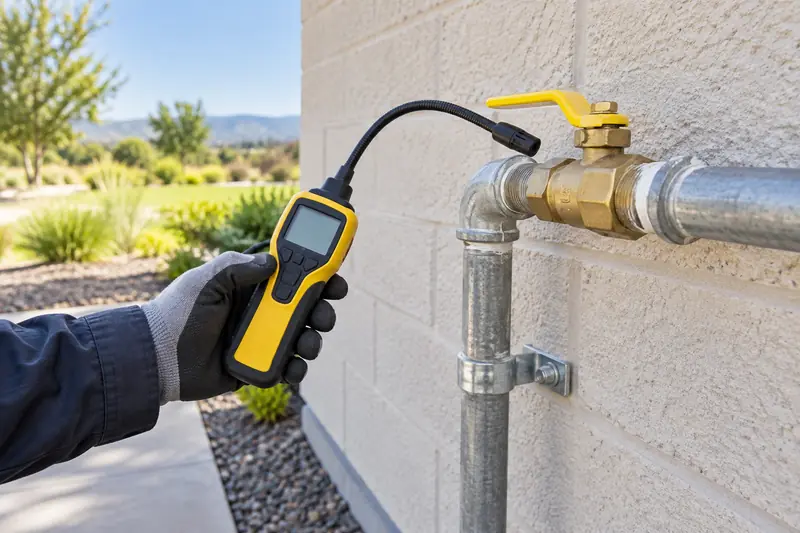
A professional may use appropriate gas-sensing equipment for accessible checks and a properly planned piping tightness test where required. Manufacturer instructions and applicable local requirements govern the work. HOME-FLEX's installation manual, for example, distinguishes piping pressure tests from appliance connection checks and warns against exposing certain regulators to test pressure. These are professional procedures, not instructions for household testing.
Request findings that identify the tested portion, observed defect, inaccessible sections and next required action. If a result establishes leakage in a branch but not its precise position, ask how additional investigation will be authorized. Avoid assuming that a general statement such as gas checked documents every concealed pipe and connection.
Compare professional assessment methods
This comparison explains what to ask a provider after the immediate hazard has been addressed. It does not provide a safe basis for entering a suspected leak area or attempting any test yourself. Equipment must be appropriate to both the gas and the work environment.
| Professional method | Useful purpose | Limit to clarify |
|---|---|---|
| Review of utility findings and accessible piping | Defines the affected system and visible concerns. | Concealed conditions need additional evidence. |
| Suitable combustible-gas instrument | Detects a response near accessible components. | Sensor capabilities vary; a locating tool is not automatically a personal safety monitor. |
| Approved leak-check fluid at suitable connections | Helps check particular accessible joints under professional control. | It is a local connection check, not proof about an entire hidden branch. |
| Planned piping tightness or pressure test | Assesses an appropriately isolated piping section. | It does not necessarily pinpoint the defect; appliances and regulators require protection. |
| Targeted access or further location work | Investigates a concealed section when evidence supports it. | Access and restoration need an agreed scope and authorization. |
Instrument readings and carbon monoxide are different issues
RIDGID's micro CD-100 manual illustrates important instrument limits: the locating tool does not identify the exact gas type or concentration and must not serve as a personal safety or confined-space monitor. The product also responds to multiple substances. Ask the provider how readings are interpreted and confirmed; an electronic response alone should not become an unsupported claim about the complete system.
Carbon monoxide is a separate hazard. CDC explains that CO is colorless and odorless and can come from fuel-burning equipment. A CO alarm and a combustible-gas detector serve different purposes unless a device is specifically designed for both. If a CO alarm sounds or you suspect CO exposure, move outside to fresh air and call 911 from safety. Do not remain inside to decide which gas may be present.
Prepare only after access is declared safe
From a safe location, collect utility notices, existing plans, appliance details and the contact information of the person authorized to approve work. Ask the provider which documents and access permissions are needed. Mention shared meters, detached buildings and outdoor gas equipment so the proposed assessment identifies the relevant customer-owned branches.
Do not clear access, move appliances or retrieve documents from an evacuated area. Do not remove a utility tag, operate a locked meter or relight equipment. For later excavation, the contractor should address utility notification and private-line locating. SoCalGas notes that utility marking does not cover customer-owned gas lines; discuss both parts of the locating scope.
Cost factors, repair scope and service restoration
Discuss the number of branches, concealed or buried piping, the available utility findings and the need for separate testing or access work. Ask for a written diagnostic scope and an authorization process for additional investigation. A proposal should identify whether it includes a report, repair, permits, inspection coordination or restoration of opened surfaces.
Detection, repair and gas restoration are separate steps. The utility may need its own checks before restoring supply. SoCalGas advises customers never to restore gas service themselves. Ask who coordinates each remaining action and what documentation the utility requires. A provider's arrival time or completed repair does not establish when gas service can resume.
Gas Leak Detection questions
Who should I contact first if I suspect a gas leak?
Leave the area immediately. From a safe location, call 911 and your local gas utility or pipeline operator, then follow responders' instructions. Do not wait for a Hydriva call, a contractor appointment, or a household detector reading. Do not try to locate or repair the leak. This page also explains later professional assessment after the immediate hazard has been addressed.
What affects the scope and cost after a gas emergency is addressed?
After responders permit the next step, the utility findings, affected customer piping, accessible branches, and required inspection coordination shape the work. Separate diagnosis, repair, and utility restoration. A routine quote or appointment is not emergency clearance; follow the utility's instructions before arranging later assessment.
Which local details are needed for a later customer-piping assessment?
Once access is declared safe, provide the full address and state, local utility, service status, and written utility findings. These details help define the permitted work. For a current suspected leak, leave immediately and call 911 and the utility from safety instead of waiting for a routine appointment.
Can I remain inside if a home detector is silent?
No. If you suspect a gas leak, leave regardless of a silent device. A detector only responds within its design capabilities and conditions, and it does not replace the utility's safety assessment. Do not turn devices on or search for a reading in the suspected area. Call from a safe location and explain the concern to responders, who can direct the next steps.
Is a carbon monoxide alarm the same as a natural gas detector?
No. CO detection and combustible-gas detection address different hazards. Some products combine functions, but a standard CO alarm should not be assumed to detect a natural gas leak. CDC notes that CO itself has no smell. For a CO alarm or suspected exposure, move to fresh air and call 911 from safety. Do not use the absence of a rotten-egg odor to dismiss either concern.
What if the utility says the leak is on my side of the meter?
Follow the utility's safety instructions and keep any written findings. After the immediate hazard is addressed, ask an appropriate independent provider to define the customer-piping assessment and repair scope. Confirm who authorizes the work and who coordinates any required inspection or utility return. Do not alter the meter, remove tags or attempt to restore supply yourself. Ownership and repair responsibility should be confirmed for the affected installation.
Does a successful piping test mean gas can be turned back on immediately?
A test result applies to the portion tested under the recorded conditions. It does not automatically complete appliance checks, inspections or utility restoration requirements. Ask for the report and the remaining steps before expecting service to resume. SoCalGas directs customers not to restore their own service. Follow the instructions of your actual utility and the emergency responders; a diagnostic report alone is not permission to operate a locked meter or relight equipment.
Related inspection guides
Compare other leak detection services from Hydriva, or find your city and state in the location directory.
Sources and further reading
- PHMSA: Pipeline emergency reporting from a safe location
- PHMSA: Pipeline leak recognition and emergency response
- SoCalGas: Natural gas leak recognition, evacuation and reporting number
- SoCalGas: Natural gas safety guide and warning signs
- SoCalGas: Maintaining customer-owned gas lines
- SoCalGas: Service guidebook and customer-owned line marking limits
- RIDGID: Combustible gas detector capabilities
- RIDGID: CD-100 manual and safety-monitor limitations
- HOME-FLEX: Professional pressure testing and appliance connection checks
- CDC: Carbon monoxide basics
- SoCalGas: Restoration guidance and prohibition on customer self-restoration