Puyallup neighborhoods and local areas
- Downtown PuyallupThe city's neighborhood plan identifies Downtown Puyallup as one of its two growth centers.
- South Hill Regional Growth CenterThe municipal neighborhood plan defines a South Hill growth-center area within Puyallup.
These names describe places; they do not establish utility responsibility, pipe condition, or appointment availability. Follow the local references in the city and state directory for the type of area and supporting source.
Check the property jurisdiction before planning repair
Puyallup's Development Engineering FAQ explains that some properties with a Puyallup mailing address are in unincorporated Pierce County. It links a public map for checking addresses and parcels. Start with the actual property location when asking about permits or public infrastructure. The mailing city is useful for correspondence, but it cannot settle every question about responsibility.
Pierce County separately identifies South Hill as an unincorporated community. That wider community should not be confused with Puyallup's city-designated South Hill Regional Growth Center. Give the full address when contacting a provider, rather than saying only South Hill. The distinction matters when coordinating the appropriate authority and any work extending beyond a privately controlled area.
Keep three facts together: the site address, the supplier named on the water account, and the property jurisdiction. They answer different questions. If you are a tenant or arranging work for someone else, identify the owner or manager as well. This preparation can prevent an inspection request from reaching someone without the information or authority needed to move it forward.
Separate the public service question from the private concern
The city's Water Division describes its responsibility for public service up to customers' meters and explains that property owners must maintain their private piping. Ask the supplier to clarify an uncertain boundary. Water appearing near a street, meter, or property edge does not alone establish the point of failure or which organization should investigate it.
Describe the observation before assigning blame: where water appears, when it began, and whether a utility has already attended. Retain any reference number or written advice. If the supplier has checked its system, ask what it actually checked and what question remains. A statement that further private investigation is needed is more useful when accompanied by those limits.
Keep away from unstable ground, exposed electrical equipment, and unsafe road areas. Do not remove a meter or alter utility connections. If the situation needs immediate utility response, use that supplier's emergency channel rather than waiting for a routine private appointment. Hydriva's enquiry line is for discussing inspection needs, not dispatching the public water department.
Describe the pattern without deciding the cause too early
Write a short sequence of events before the call. An increased meter reading, a damp part of the yard, and reduced performance at a fixture should be recorded as separate observations. Include which happened first and whether anything changed after a repair, watering cycle, or period away from the property. The sequence helps define a test question without treating every symptom as one proven fault.
For a billing concern, bring consumption and reading dates rather than only the amount charged. For visible moisture, include photographs that show both the affected spot and its surroundings. Identify known irrigation branches, outbuildings, and water features connected to the property. Mention an automatically refilling fixture or equipment cycle so the provider can consider known uses before proposing a concealed-service investigation.
Be clear about what you do not know. A route remembered by a previous owner is different from a documented installation drawing. A sound heard once is different from a repeatable observation. Neither needs to be discarded, but label it accurately. Do not repeatedly run a fixture that is causing damage simply to make a symptom easier to demonstrate.
Define what underground detection should establish
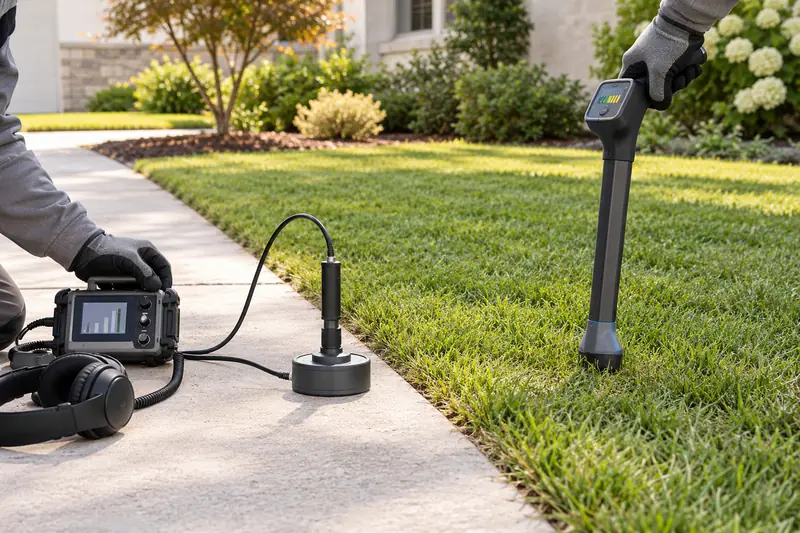
Ask whether the proposed visit is intended to investigate a particular supply section, identify a likely location, or help distinguish between connected branches. Confirm the start and end points in language you understand. A service described as underground detection may not include every outdoor pipe or every system crossing the property. Clarify those boundaries while discussing the appointment.
Ask what the provider needs to know about the existing line and what information it expects to produce. If access is limited or the route is uncertain, find out how those limitations affect the work. The proposal should explain the next decision supported by a result, including what happens when no fault is demonstrated during the visit.
| Question before booking | Why it matters | What to request |
|---|---|---|
| Which pipe or branch is included? | Separate systems can require separate investigations. | Named test boundaries and exclusions |
| Is the route known or only suspected? | A location claim needs a clear physical reference. | A sketch or explanation of route uncertainty |
| What if the result is inconclusive? | Further work should not be an unexplained surprise. | Findings and a proposed next step |
| Is excavation included? | Locating and opening the ground are different stages. | Separate authorization and restoration terms |
Use the findings to compare repair options
Detection should help inform a repair decision, not replace the repair provider's assessment. Ask what has been established about the affected component and what remains unknown about the rest of the line. A proposal to repair one location and a proposal to replace a longer section are different scopes. Request the reasons for each option before comparing their totals.
For a limited repair, ask which exposed section would be corrected and how the result would be checked. For replacement, ask about the proposed route, connections, access locations, and surfaces affected. Do not assume that a small digging area means all restoration is included, or that a replacement recommendation follows automatically from one suspected leak. The written proposal should state its basis.
Keep detection evidence available to the repair contractor, but allow for findings to change after access. If the exposed condition differs from the initial interpretation, request an explanation before expanded work proceeds. Agree who can approve that change and how revised scope will be documented. This avoids treating the first location mark as unrestricted permission to continue opening the property.
Arrange permission, permits, and restoration deliberately
Puyallup's Development Engineering FAQ states that repairing or replacing a private water or sewer service requires a utility service repair permit. Confirm current requirements with the authority for the address and proposed work. A detection enquiry is not a permit approval, and a mailing address does not establish that city procedures govern the property.
Ask the repair provider who handles applications, required inspections, and coordination before ground disturbance. Identify any shared driveway, tenant space, gate, or landscaped area involved in access. If another owner controls part of the route, obtain the necessary agreement through the appropriate parties. Do not assume permission to inspect your building extends to work elsewhere along a suspected line.
Discuss the final condition of the work area before authorizing access. Separate temporary making-safe work from paving, planting, or finish restoration if different providers will handle them. Ask who will explain any restrictions on using the affected area afterward. A clear handover should identify unfinished restoration so it is not mistaken for a completed part of the original appointment.
Keep billing evidence separate from the repair decision
Puyallup publishes a leak-adjustment policy and request form through its utility-billing pages. Contact the actual supplier about the current application, documentation, and eligibility for your account. Do not assume the city's process applies to every property with a Puyallup address. Neither booking detection nor receiving a repair invoice guarantees a credit.
Keep the original usage statement, dates of the concern, detection findings, and repair record together. Ask for documents describing the work actually performed, not only a general label such as plumbing service. Where the provider supplies photographs or a diagram, retain them with the relevant date. These records can help explain the sequence without suggesting that the supplier must accept a particular conclusion.
A billing review and a contractor disagreement are separate conversations. Direct questions about utility charges to the supplier and questions about purchased work to the provider responsible for that agreement. Ask the supplier how to manage outstanding bills during a review. Do not postpone necessary property protection merely because an adjustment request has not yet received a decision.
Prepare a focused call for your Puyallup address
When contacting Hydriva, begin with the unresolved problem and the system you think is involved. Explain whether the utility has attended, whether a private repair has already been attempted, and what evidence is available. Mention access restrictions and the person authorized to approve an inspection. These details support a more useful discussion than requesting every kind of leak test at once.
Availability, included work, and price should be confirmed for the actual address. Ask whether the proposed service addresses your concern and what documentation accompanies it. If your question is about a drain, roof, or irrigation branch rather than a buried supply, say so. The appropriate starting service is the one that can address the observation you have, with its limitations explained.
Puyallup leak detection questions
Does a Puyallup postal address mean the city supplies my water?
Do not rely on the mailing city alone. Check the supplier shown on the account and use official property information when confirming jurisdiction. The city specifically notes that some Puyallup-addressed parcels are in unincorporated Pierce County.
Is the South Hill community the same as the city's growth center?
They are different geographic descriptions. Pierce County identifies the unincorporated South Hill community, while the city has a defined South Hill Regional Growth Center. Use the property address to resolve which authority and supplier are relevant.
Can I approve digging as part of the detection phone call?
First establish the inspection scope and what evidence supports access. Ground disturbance involves additional coordination and permission. Ask who handles locating requirements, permits, and restoration before treating a detection booking as authorization for excavation.
What determines the price of a private inspection?
The defined system, access, route uncertainty, investigation time, and reporting requirements affect the proposal. Ask about exclusions and additional work before accepting it. Call (844) 776-0313 with the property details to discuss the appropriate inspection and availability.
Choose a relevant service
Explore Hydriva Leak Detection or return to locations and neighborhoods.