
East Providence neighborhoods and local areas
- PhillipsdaleNamed as a neighborhood in the city's history overview.
- RumfordNamed as a neighborhood in the city's history overview.
- WatchemoketNamed as a neighborhood in the city's history overview.
- Kent HeightsNamed as a neighborhood in the city's history overview.
- RiversideNamed as a neighborhood in the city's history overview.
These names describe places; they do not establish utility responsibility, pipe condition, or appointment availability. Follow the local references in the city and state directory for the type of area and supporting source.
Separate water use from the sewer-billing question
East Providence's published billing explanation distinguishes consumption charges from fixed fees and describes deduct-meter readings for water that does not enter the sewer system. That distinction matters when an outdoor-use concern first appears as a larger statement. Use the city's Water Utilities Division for an explanation of your own account; the linked billing document is not a current-price quotation.
Ask the account team what each reading represents before comparing totals. If your property has more than one meter, label the records by the device or account description the utility uses. Do not combine different readings or subtract one from another based on appearance alone. A plumbing provider needs to know which record relates to the system being investigated.
Keep two questions on your notes: why the recorded water use changed, and how the bill was calculated. Finding a physical problem can help explain use without settling an account review. Conversely, understanding a charge does not resolve unexplained moisture. Treat these as related conversations with different evidence and different people responsible for answering them.
Map the ordinary uses before suspecting a buried pipe
List the water uses you know about at the property, including outdoor taps, irrigation and equipment that fills automatically. Note changes in schedules, occupancy or maintenance around the time the concern began. You are not being asked to draw an exact plumbing plan. The purpose is to avoid leaving a regular use out of the discussion when describing what seems unexplained.
For an outdoor symptom, identify the area with a simple landmark such as the side gate or the rear planting bed. Say whether the patch appears after watering, remains between watering periods or has changed since a system was switched off by an authorized person. A photograph should show the surroundings as well as the wet spot.
Do not excavate to test a theory or operate an unfamiliar buried valve. An inspection should first establish which system is relevant and what checks are appropriate. If an old drawing suggests a route, label it as an old drawing rather than a confirmed location. Keep visible symptoms, documented routes and guesses separate in your description.
Use the right appointment for the observation
A provider who investigates supply piping may not include irrigation controls, drainage containment, a roof or building-envelope entry in the same visit. Ask for the scope in ordinary language. Describe what you need to learn and request confirmation that the proposed appointment can address it. A broad advertisement is not a substitute for agreement about your property.
Where several symptoms exist, prioritize them with the provider rather than assuming one cause explains everything. For example, an increased consumption record and a basement stain deserve to be described independently. Give each its own start date and timing. The provider can then explain whether a shared investigation makes sense or whether a separate specialist is appropriate.
| Concern | Service discussion | Preparation |
|---|---|---|
| Outdoor water use has changed | Irrigation or private supply assessment | Controller schedule and the relevant account record |
| A damp area follows fixture operation | Plumbing or drainage investigation | Fixture name, room and timing |
| A buried private line is suspected | Underground leak detection | Existing drawings and access restrictions |
| Moisture follows rain instead of water use | Roof or building-moisture assessment | Dated photographs and weather observations |
Keep municipal equipment questions with Water Utilities
The city's Water Utilities Division lists meter reading and servicing, customer-account support and emergency water-system repairs among its functions. Its official page links a water-or-sewer issue reporting route. Use that route or the city's published contact information when the concern may involve municipal infrastructure. Hydriva is not the city water department.
Before arranging private work near a meter or service connection, ask who controls the equipment involved and what access is permitted. Explain the exact location rather than describing everything outside the building as city-owned or everything inside as private. Ownership and work authorization should be clarified for the actual component, not inferred from a neighborhood label.
If water is creating an immediate hazard, use the appropriate emergency or utility response instead of waiting for an ordinary appointment. Keep away from wet electrical equipment and unstable areas. For a nonurgent meter question, photograph only equipment that is safely accessible and leave covers, seals and adjustments to the people authorized to handle them.
Plan the appointment around the building's actual access
Tell the provider about separate units, locked service rooms, tenants, a business operating schedule or another person who manages the grounds. Explain which spaces you can authorize them to enter. If the investigation may require access elsewhere, arrange permission in advance rather than assuming a neighbor or tenant will be available when the appointment starts.
Make a short list of previous work: an irrigation shutdown, a fixture replacement, a drain visit or a repair near the affected area. Include dates and reports where possible. Ask the next provider what information from that earlier work would be helpful. This avoids paying to repeat a question that another person has already answered and documented.
Choose one contact to collect the findings when several people are involved. That person should understand what was approved and who can authorize a change. For a managed property, separate permission to investigate from permission to interrupt service, expose a pipe or carry out a repair. Those decisions may belong to different people.
Know what a detection result should tell you
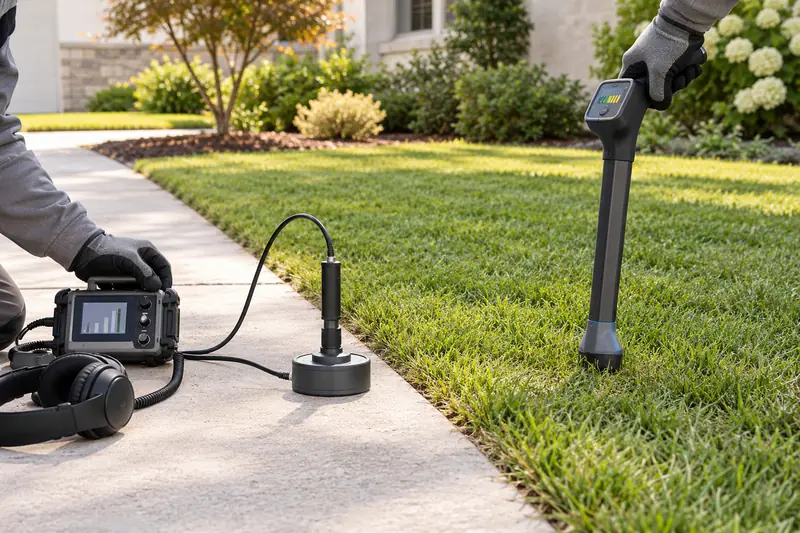
Ask for a description of what the investigation found, what evidence supports it and what remains uncertain. If a suspected location is marked, request a reference that will remain recognizable after the visit. A mark by itself does not explain which line was considered or whether the result was confirmed under the conditions present that day.
Ask how inaccessible sections and untested equipment will be documented. A negative result should be tied to the checks actually performed, not interpreted as a guarantee about the entire property. If the symptom is intermittent, explain when it has been observed and ask how that affects the value and limitations of the proposed visit.
Treat a recommendation for opening a surface as another decision. Request the reason for the location, what the opening is intended to establish and who will manage restoration. Ask whether the evidence supports proceeding now or whether another non-disruptive observation could change the plan. The agreement should make additional authorization clear.
Evaluate cost by scope, not a citywide price promise
Costs depend on what is being investigated and what access is available. Describe whether the concern involves one indoor fixture, a private buried route, several outdoor branches or multiple occupied spaces. Ask what documentation is included and how extra time or a follow-up visit is handled. No fixed East Providence inspection price is assumed in this guide.
Compare the same deliverable when reviewing proposals. One may cover investigation only; another may include an immediate repair if a particular accessible problem is found. Request those conditions in writing. Ask what happens when the result is inconclusive or when the provider identifies a system outside the agreed scope.
Keep the next stages distinct in your budget. Detection does not automatically include excavation, replacement parts, drying, finish repair or landscaping. Ask who will quote each required stage after the finding is explained. You should be able to approve the immediate task without accidentally accepting an undefined package of later work.
Use the neighborhood to identify the location, not the plumbing
East Providence's municipal history overview names Phillipsdale, Rumford, Watchemoket, Kent Heights and Riverside. They are included below as verified local references. East Providence is the city meant here; this is not a guide to Providence's East Side. Confirm the full municipality and address when making an enquiry so the property is not confused with a similarly described location.
A neighborhood's history cannot establish the age, condition or route of a particular home's pipes. Renovations and individual service arrangements need property-specific evidence. Supply any existing plans and describe known changes without extending assumptions from nearby buildings. A recent inspection record is more useful for that question than a general description of the area.
Use a unit number, building entrance or site contact where the street address alone is ambiguous. For a large property, identify the specific building or outdoor zone involved. Local-area names help orient the conversation, but service availability and the suitable investigation must still be confirmed for the actual address.
Close the work with records you can compare later
Retain the inspection findings separately from the repair description. Ask the repair provider to record the component addressed and the verification performed afterward. If the exposed condition differs from the original interpretation, request an explanation of the change. This creates a useful record for a future contractor instead of leaving several conflicting verbal accounts.
For a consumption concern, keep subsequent records with the earlier billing periods and note the repair date. For a moisture concern, preserve dated observations of the same location. Ask the responsible provider what follow-up is appropriate. Do not treat a normal-looking statement as evidence that every moisture issue has been resolved, or a dry surface as proof of the billing outcome.
Contact the utility directly about any account review and ask which documents it needs. The detector's findings and a paid repair record may answer different questions. No sewer deduction, water-bill credit or insurance payment is guaranteed by arranging an inspection. Organizing the documents helps you ask a precise question without confusing those separate decisions.
East Providence leak detection questions
Does a deduct meter find an outdoor leak?
The city's billing explanation describes its role in accounting for water not entering the sewer system. Do not treat that billing purpose as a diagnosis or a location report. Ask the utility to explain the readings, then discuss any unexplained outdoor use with the appropriate inspection provider.
What if I have a wet yard but no unusual bill?
Report both observations. Describe the timing, location and any connection to watering or rainfall. Do not assume the absence of a higher bill proves or disproves a particular source. Ask which system should be assessed before arranging digging or a private supply repair.
Can a provider inspect a rented or shared property?
Discuss access and authorization before booking. Identify the owner or manager who can permit entry and approve interruptions or additional work. Provide the affected unit and any shared spaces that may need consideration; a resident's report alone does not establish permission for work elsewhere.
How do I discuss an East Providence appointment?
Call (844) 776-0313 with the complete property address, the main symptom and any previous findings. Explain whether the concern involves indoor plumbing, outdoor use, a buried line or building moisture. Availability, scope and pricing must be confirmed for the particular property.
Choose a relevant service
Explore Hydriva Leak Detection or return to locations and neighborhoods.