
Start with the type of leak
Air conditioners and heat pumps move heat using refrigerant circulating through a closed circuit. Water in a drain pan belongs to a separate condensate system. A puddle beneath equipment does not establish refrigerant loss, and poor cooling alone does not establish a leaking coil.
Identify whether you need a cooling-performance assessment, a refrigerant search or a condensate-water investigation. These may overlap, but the provider should explain which problem each proposed test addresses. The Department of Energy's Home Cooling 101 guide identifies low refrigerant, dirty filters, drainage faults and control problems as different possible explanations for cooling trouble.
Identify the affected equipment and whether the concern is refrigerant loss or visible water. A useful inspection scope defines the system, accessible components, proposed methods, and reporting before a repair decision is made.
Symptoms to describe before an assessment
Record when the problem appears and whether anything changed after maintenance. Give the provider observations rather than a presumed failed component. Useful details include:
- Rooms taking longer to cool despite an unchanged thermostat setting.
- Previous service records showing refrigerant added more than once.
- Ice visible on accessible tubing or equipment, without removing panels.
- Oil-like residue near an accessible fitting, which needs confirmation.
- Water overflowing a pan or appearing near a condensate drain.
- An equipment alarm or service report identifying a charge-related fault.
Possible causes and competing explanations
A provider may inspect joints, service valves, coils and accessible tubing for evidence of a refrigerant escape. Ask whether the search includes both indoor and outdoor equipment and the connecting line set. A report limited to exposed connections should identify that boundary.
Cooling problems can also involve restricted airflow, dirty equipment, thermostat settings or electrical controls. Condensate trouble can involve a blocked drain or another water-management fault. A previous low-charge diagnosis is useful history, but it does not show where refrigerant escaped or whether the original charge was correct.
Supply the previous findings before approving more refrigerant. Ask what evidence supports loss, what alternatives remain and whether the provider can distinguish a suspected component from a confirmed leak location.
How a provider can structure the diagnosis
First, identify the equipment model, refrigerant and service history. The provider can review operating conditions and accessible components to decide whether a refrigerant search is appropriate. Discuss whether equipment must run, stop or be isolated during different stages.
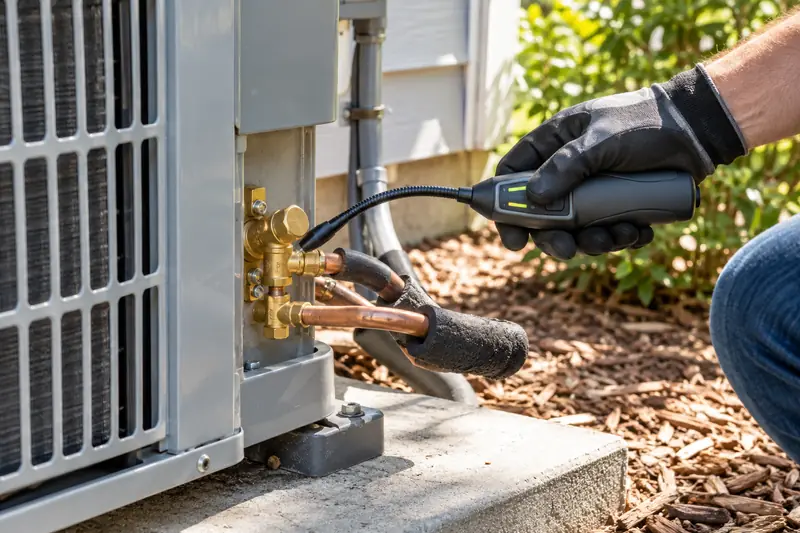
Next, choose a location method suitable for the refrigerant and access. An electronic detector may help examine accessible components, while bubble solution can check a particular exposed connection. A controlled pressure test may establish whether an isolated section holds pressure, but a separate search may still be needed to identify the escape point.
EPA distinguishes locating leaks from tests that only indicate leakage. Its technician guidance explains that pressure and vacuum decay checks alone do not identify a location.
Finally, request the findings and unresolved areas before authorizing repair. If a coil cabinet, ceiling or concealed line section needs access, agree on the extent and who restores it.
Comparing refrigerant test methods
These are industry options, not a list of Hydriva equipment. Manufacturer instructions and the equipment's service requirements govern selection. Fieldpiece documentation describes refrigerant-specific electronic detection and temperature compensation during nitrogen pressure testing.
| Method | Useful purpose | Important limitation |
|---|---|---|
| Electronic refrigerant detection | Search accessible coils, joints and valves for escaping refrigerant. | Detector compatibility, correct operation and access matter; an alarm needs interpretation. |
| Bubble solution | Confirm an escape at a particular exposed joint or component. | The surface must be reachable; it is not a survey of concealed tubing. |
| Dry nitrogen pressure testing | Check an appropriately prepared, isolated circuit or section for pressure loss. | Temperature changes affect readings; pressure loss alone does not locate the leak. |
| Vacuum decay testing | Support assessment of an evacuated circuit before charging. | Moisture and test-setup issues complicate interpretation; it does not pinpoint an escape. |
| Condensate inspection | Investigate drain, pan and water-removal problems. | This examines a different system and cannot establish refrigerant-circuit tightness. |
Prepare access and service information
Gather the model number, refrigerant information if visible, warranty documents and prior invoices. Note dates of recharge, repeated symptoms and any recently replaced parts. Photos of visible water or ice can help describe an intermittent problem without running equipment again solely to reproduce it.
Arrange authorized access to indoor and outdoor units. Keep the route clear and identify locked mechanical rooms or roof access that requires coordination. Ask the provider whether operation should continue before arrival; avoid removing covers, connecting gauges or handling refrigerant.
EPA requires appropriate technician certification for work that can open the refrigerant circuit. Identify the refrigerant and the proposed work before arranging access. The service record should distinguish a leak search, a repair, any refrigerant added, and the method used to check the addressed component afterward.
- Tell the provider about alarms and any suspected hazardous release.
- Identify tenant access restrictions and who can authorize a shutdown.
- Keep maintenance records available instead of relying on memory.
What affects assessment and repair costs
Costs depend on the number of circuits, equipment layout, accessibility and how much testing the initial evidence justifies. An exposed connection and a concealed line set present different search scopes. Recovery, pressure testing and a return visit may be separate items.
Ask for written terms defining the initial assessment, the point at which additional authorization is needed and what documentation is included. Separate detection from refrigerant handling, parts, component replacement, recharge, access openings and restoration.
For a repair-versus-replacement decision, request the evidence for the failed component, relevant warranty coverage and the proposed verification steps. Age alone does not explain a particular failure. Compare proposals with the same diagnostic findings so a repair option and replacement option address the same problem.
Detection limits and the repair handoff
An inaccessible or intermittent leak may remain unresolved after a visit. A provider should state what was tested, under which conditions and which areas were excluded. A negative search means no leak was detected within that scope; it does not establish that every concealed component is sound.
Locating a leak does not complete the repair. Component work, appropriate refrigerant handling and checks after repair belong in a separate agreed scope. EPA's refrigerant-management guidance prohibits intentional venting during servicing, subject to its stated exceptions.
Some larger refrigeration applications have additional leak-repair and recordkeeping requirements. Applicability depends on the appliance and refrigerant, so avoid applying a commercial rule to every household air conditioner. Ask the servicing provider to identify requirements relevant to the actual equipment.
Discuss the affected HVAC equipment
Describe whether the concern is weak cooling, repeated refrigerant loss or visible water. Include the property locality, equipment type and available records. Call Hydriva with those details to discuss the relevant inspection, equipment access, and the next steps after an earlier service visit.
For a building with several systems, identify the affected equipment by its service label or another reliable reference. Keep previous service reports with that identifier so that refrigerant additions or findings from one system are not mistakenly attributed to another. Note which occupied area is affected and when the symptom was reported. A tenant's room description and a technician's equipment identifier should be connected in the record before comparing the history.
Ask the provider to distinguish the suspected refrigerant concern from any visible water problem in its report. If both are investigated, request separate findings and next steps. Record the relevant inspection conditions and any limits on access or operation. When repair is proposed, ask what verification will apply to the addressed component and what other faults remain outside that scope. Keeping equipment identity, water observations, refrigerant findings, and repair authorization distinct makes a later visit more useful without treating an incomplete history as evidence of a specific failure.
Inspection notes
HVAC & Refrigerant Leak Detection questions
What affects the cost of an HVAC refrigerant-leak search?
Equipment type, refrigerant, accessible components, prior service records, and the testing needed shape the scope. Separate the leak search from repair, refrigerant work, and verification. Call with the affected equipment identifier and service history to discuss the inspection rather than assuming a refrigerant addition resolves the concern.
What should I provide when calling about local HVAC leak detection?
Give the address and state, equipment type, and whether the symptom is refrigerant loss or visible water. Mention restricted roof or equipment-room access and any occupied spaces affected. Call with those details to discuss the suitable service and confirm availability for that system.
Does adding refrigerant fix a leak?
Adding refrigerant changes the charge but does not close an escape point. Ask whether the provider has confirmed a leak, identified its location and proposed a repair. Also ask whether an incorrect previous charge could explain the finding. Request separate documentation for refrigerant added, the component repaired and the checks performed afterward.
Is the water beside my air conditioner refrigerant?
A visible puddle is not sufficient evidence of refrigerant loss. Air-conditioning equipment also collects water from the air, and drainage faults can put that water where it does not belong. Describe where the puddle appears and when. The provider should investigate the water path and assess the cooling circuit separately if the symptoms support it.
Can a thermal camera locate every refrigerant leak?
No. Ordinary building thermal cameras display surface temperature patterns and cannot see through walls. That is different from specialized gas-imaging equipment. Ask what instrument is proposed, whether it is suitable for the refrigerant and what confirms the finding. A temperature pattern alone should not be presented as proof of an exact concealed refrigerant leak.
Why might a leak search need another visit?
The first assessment may identify an inaccessible section, a test requiring an agreed shutdown or conditions that were absent during inspection. Ask what a return visit would resolve and whether access or equipment preparation must happen first. The written findings should distinguish a confirmed leak, a suspected area and a circuit that has not yet been adequately tested.
Should a leaking coil be repaired or replaced?
That decision requires the actual findings, repair feasibility, component availability and equipment warranty terms. Ask for options that include the related refrigerant work and verification, rather than comparing a part-only proposal with a complete installation. Have the provider explain whether the diagnosis is confirmed and what uncertainty remains before approving a major component or system replacement.
Related inspection guides
Compare other leak detection services from Hydriva, or find your city and state in the location directory.
Sources and further reading
- Department of Energy: Home Cooling 101
- EPA: Refrigerant technician questions, locating leaks and verification
- Fieldpiece: DR82 refrigerant detector capabilities and operating requirements
- Fieldpiece: SM382V and SM482V manual, nitrogen and vacuum tests
- EPA: Managing refrigeration and air-conditioning equipment
- EPA: HFC management questions and appliance-specific leak-repair requirements
- FLIR: What thermal cameras can and cannot see